How to Get an Accurate Software Development Quote
You ask three developers for a price on the same website and get ₦180,000, ₦650,000 and ₦1.4 million. Nobody is necessarily cheating. But now you have no idea which number to trust, and the cheapest one is very tempting. Here is the uncomfortable truth about software quotes: a quote is only as accurate as the information it was built from. If the developer had to guess, the price is a guess too. Your job is to give them less to guess about.
Why quotes are so different from each other
Three things usually explain the gap. First, each developer imagined a slightly different project, because the brief was thin. Second, each one included different things: one counted content writing and testing, another did not. Third, they work differently. A freelancer with low costs, a small studio and a large agency really do charge different amounts for the same work. So the first step to a better quote is not to haggle. It is to make everyone quote the same thing.
Step 1: Write the brief before you ask for prices
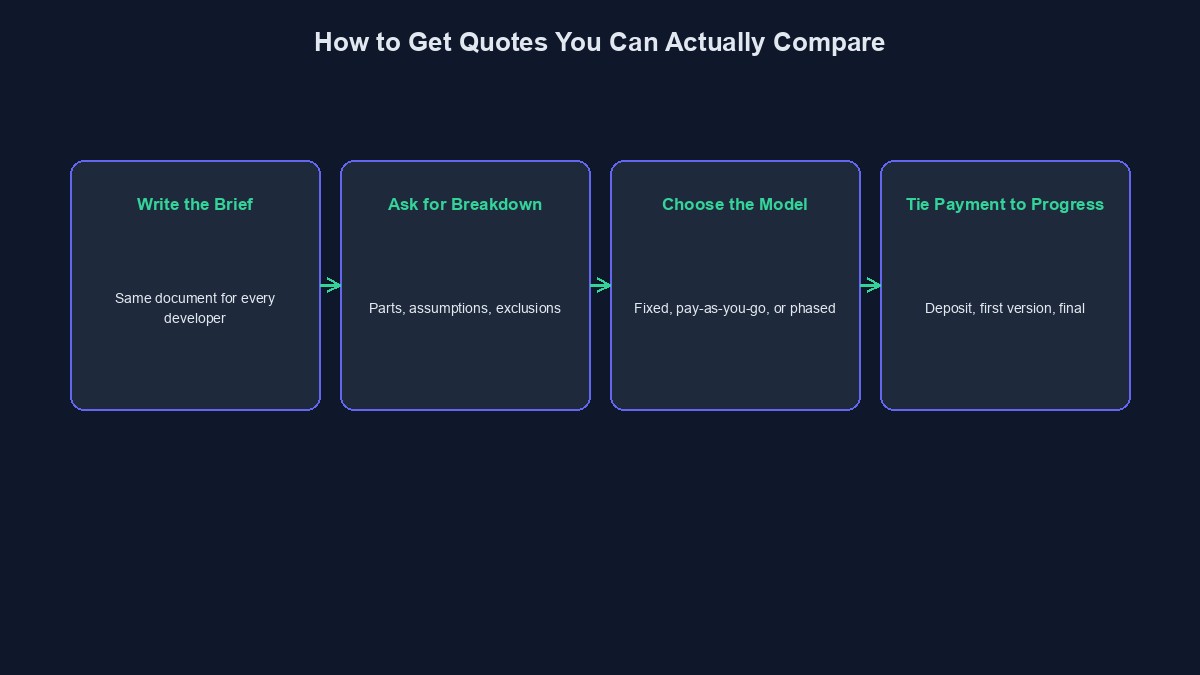
Send the same written brief to every developer. It can be a page or two: the goal, the pages, the must-have features, what is out of scope, your deadline. Our guide on preparing website requirements shows exactly how. If you only say "I need a website for my business" over a phone call, you will get quotes that cannot be compared.
Step 2: Ask for a breakdown, not one number
A single total tells you nothing. Ask for the price split into parts: design, building, content setup, payment connection, testing, training, hosting, and support after launch. When two quotes are far apart, the breakdown shows why. Maybe one included the admin area and the other forgot it.
Step 3: Ask what the quote assumes
Every quote rests on assumptions, even if they are not written down. "Assumes the client provides all text and photos." "Assumes up to two rounds of changes." "Assumes one payment gateway." Ask each developer to list theirs. Then check that they match what you think you are getting. Most arguments later come from an assumption nobody said out loud.
Step 4: Ask what is not included
This is the question that saves the most money. Domain name? Hosting? Writing the content? Product photos? Fixing bugs after launch? Changes after approval? A fair quote lists these without being pushed. A suspiciously cheap quote often turns out to leave most of them out.
Step 5: Understand fixed price versus pay-as-you-go
In a fixed-price quote, you agree on one total for a defined list of work. This is good when the work is small and clear. The developer carries the risk, so they usually add a safety margin, and any change you ask for later costs extra. In a time-based arrangement, you pay for the hours or days actually worked. This suits projects that are still taking shape, but you need a ceiling and regular progress reports so the bill cannot run away. Neither option makes a poor estimate better. It only decides who pays when the estimate turns out wrong. Many careful clients use a mix: pay for a short planning phase first, then fix the price for the build once the plan is clear.
Step 6: Agree how changes will be handled
You will change your mind. That is normal. What matters is the process: you describe the change, the developer says what it costs and how long it takes, and you approve it in writing before work starts. A developer with no process for changes will either say yes to everything and then resent it, or add costs without warning.
Step 7: Tie payments to progress
A common and sensible pattern is a deposit to start, a payment when a working first version is shown, and the final payment when everything is delivered and checked. Be wary of anyone who asks for the whole amount before any work is visible.
What realistic numbers look like in Nigeria
Prices move with the exchange rate, so use these as a sense-check and not a price list. At around ₦1,330 to the dollar: a simple template-based business site often lands between ₦150,000 and ₦500,000 (about $115–$375). A custom-designed business site is more like ₦500,000 to ₦2,000,000 ($375–$1,500). An online shop or web app starts around ₦400,000 ($300) for a basic template-based store and climbs well past ₦3,000,000 ($2,250) when built from scratch. You will find more detail in our guide on what a website costs in Nigeria. If a quote sits far outside these ranges, that is a reason to ask questions, not to panic.
Leave a little room
Even a good quote can run into small surprises. Many people keep an extra ten to twenty percent aside as a cushion for changes. That is a rule of thumb and not a law, but it is much less painful to have it and not need it than the other way around.
Warning signs in a quote
A price with no questions asked. If someone quotes in five minutes without asking what you need, the number is made up.
"Unlimited" anything. Unlimited revisions, unlimited pages. Nobody can deliver unlimited work for a fixed price, so something will give.
No written scope. If it is not on paper, it is not part of the deal.
Short glossary
Scope: the list of what is included in the work. Milestone: a checkpoint in the project that triggers a payment. Change request: a written request to add or alter something after the scope is agreed.
Where to go from here
Once you have two or three comparable quotes, the next question is who to trust with them. Our guide on evaluating a developer when you do not code helps with that. If you would like a quote from us, send a custom project request and ask for the breakdown, the assumptions and the exclusions. You should ask every developer for those, including us.
Comments
No comments yet. Be the first to share your thoughts.