REST API vs SOAP API: What's the Difference?
If you have spent any real time reading API documentation, you have probably run into the word "SOAP" sitting oddly next to "REST," usually in an older system's documentation, and wondered whether it actually matters which one you are dealing with. It does, in a few specific, practical ways. This guide explains the real difference, honestly, including why one of them has quietly become the default almost everywhere, and where the other one genuinely still shows up.
Two different ways of agreeing how computers should talk
Both REST and SOAP are approaches to a genuinely old problem: how should two separate pieces of software, possibly built by two completely different companies, agree on the shape of a request and a response well enough to actually understand each other. They solve this the same underlying problem in quite different ways, and the difference shapes almost everything else about how each one feels to actually work with.
What REST actually is, in plain terms
REST is less a strict, formal standard and more a set of practical conventions most modern APIs have settled into. A REST API typically uses plain web addresses to represent specific things, a customer, an order, a transaction, and the standard web actions, GET, POST, PUT, DELETE, to say what you want to do with that thing. Data is almost always sent and received as JSON, a format that is genuinely easy to read, even for a person who is not the developer who wrote it. This simplicity is exactly why REST has become the practical default, it is quick to learn, quick to test, and quick to actually build against.
What SOAP actually is, in plain terms
SOAP is older, stricter, and considerably more formal. Every request and response follows a specific, rigid structure written in XML, a more verbose format than JSON, wrapped in a defined "envelope" with clearly specified sections. A SOAP API usually comes with a formal contract document describing, in exhaustive detail, exactly what every request must contain and exactly what every response will return, which makes it genuinely predictable, but also considerably more work to read, write, and test against than a typical REST API.
Why REST won the popularity contest
REST's real advantage is how little it asks of a developer before they can get something working. A developer can often test a REST endpoint directly in a browser or a simple tool within minutes, using a format, JSON, most developers already read comfortably. SOAP's stricter structure and heavier XML format mean more setup, more tooling, and more time before a developer sees a real result, and for most businesses building a normal website, app, or integration today, that extra formality buys real benefits they simply do not need.
Where SOAP genuinely still matters
SOAP is not obsolete, it persists specifically in situations where its strictness is actually a genuine advantage, not just extra overhead. Older banking systems, government platforms, and large enterprise software, some of it built and never rebuilt over decades, often still run on SOAP, because the rigid contract it enforces is exactly what those specific, high-stakes systems were built to rely on, and rebuilding them purely to modernise the API style is rarely worth the real risk and cost involved. If you ever find yourself integrating with an older bank, a government verification service, or a large legacy enterprise system, do not be surprised to find SOAP waiting for you there.
A real, side-by-side comparison
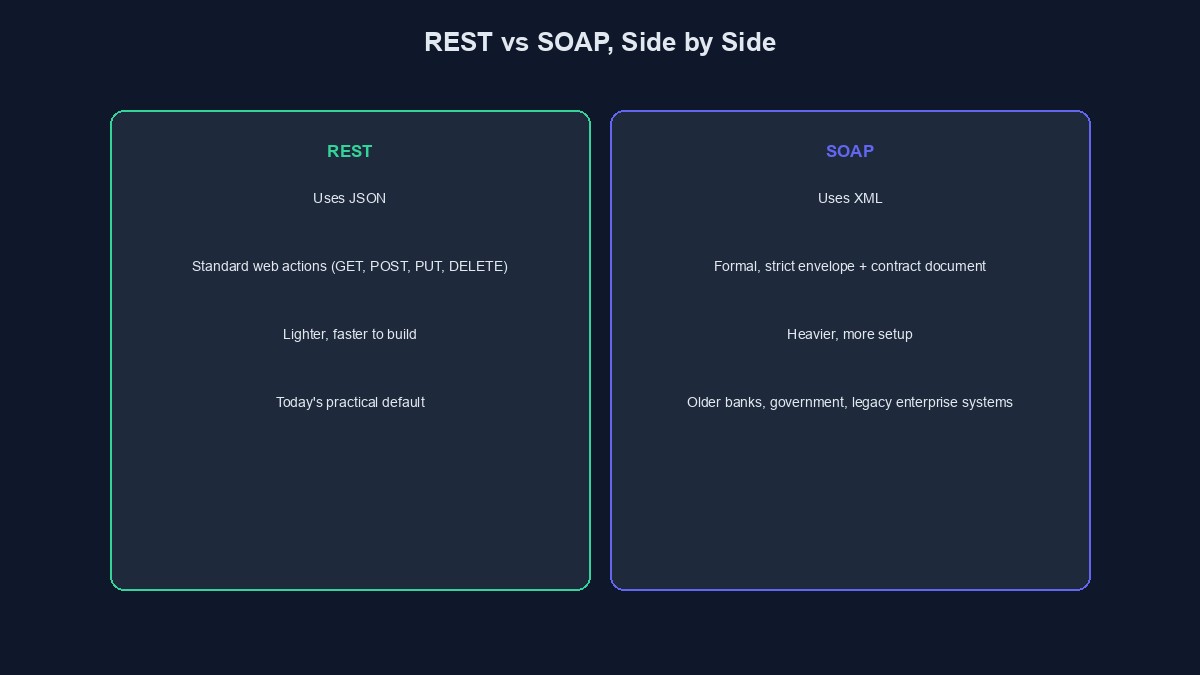
REST typically uses JSON; SOAP uses XML. REST is lighter and faster to build against; SOAP is heavier but more rigidly structured. REST relies on standard web actions and addresses; SOAP defines its own formal envelope and contract, separate from how the web ordinarily works. REST dominates modern, public-facing APIs, payment gateways, social platforms, most VTU and ecommerce integrations; SOAP persists mainly in older, high-stakes enterprise and government systems built before REST became the practical default.
What this actually means for you, practically
If you are building a new website, app, or integration today, and you get to choose, REST is very likely the right choice, and is what nearly every modern provider, payment gateways, SMS services, vending APIs, already offers by default. You genuinely do not need to learn SOAP to build most things, and most developers entering the field today can go years without touching it directly. The one time it matters is when you are integrating with an existing system that was already built on SOAP, typically an older institution, where the choice was made for you long before you arrived, and you simply need to work with the format that system already speaks.
A worked example: the same task, two different worlds
Picture a fintech app needing to verify a customer's bank account. If it is connecting to a modern Nigerian payment gateway, the request is almost certainly REST, a simple POST request with the account number and bank code as JSON, a quick, readable response back within seconds. If the same app needed to connect to a much older, decades-old banking system still running its original infrastructure, the request might well be SOAP instead, a formally structured XML envelope, built against a specific contract document the bank provides, considerably more setup before the very first successful call.
Mistakes worth avoiding
Assuming every API you will ever touch is REST. It is the overwhelming majority today, but not assuming this in advance saves real confusion the specific day you encounter a SOAP-based system instead.
Dismissing SOAP as simply "outdated" and irrelevant. Where it still runs, it usually runs for a real, deliberate reason, often institutional stability, not mere inertia, and treating it with that respect avoids underestimating the real work of integrating with it.
Trying to force a REST-style tool to work directly against a SOAP API without adjustment. The two formats are different enough that a tool built purely for REST usually needs a genuinely different approach, not just a small tweak, to work correctly with SOAP.
A short glossary
REST: a widely used, relatively simple set of conventions for building APIs, typically using JSON and standard web actions. SOAP: an older, more formal, XML-based standard for APIs, still common in some banking, government, and large enterprise systems. JSON: a lightweight, readable format for structuring data, used by almost all modern REST APIs. XML: a more verbose, tag-based format for structuring data, used by SOAP and some older systems.
Where to go from here
Our guide to REST APIs explained for beginners goes deeper into the specific conventions REST APIs, including our own, actually follow. If you are just getting oriented with the basic idea of an API at all, start with what an API actually is. And every integration our own platform offers, payments, SMS, VTU vending, is built as a modern REST API with JSON responses, which you can start building free and see directly in your dashboard.



Comments
No comments yet. Be the first to share your thoughts.