How to Sell Digital Products and Automatically Deliver Them to Customers
Selling a digital product, an ebook, a course, a template pack, a software licence, sounds like it should be simpler than selling a physical one, no shipping, no stock to run out of, no courier to coordinate with. In one real sense it is. But the actual mechanics of getting the right file, or the right access, into a paying customer's hands automatically and reliably are their own specific technical problem, and getting them wrong is a surprisingly common way a genuinely good digital product loses customer trust in its first few minutes.
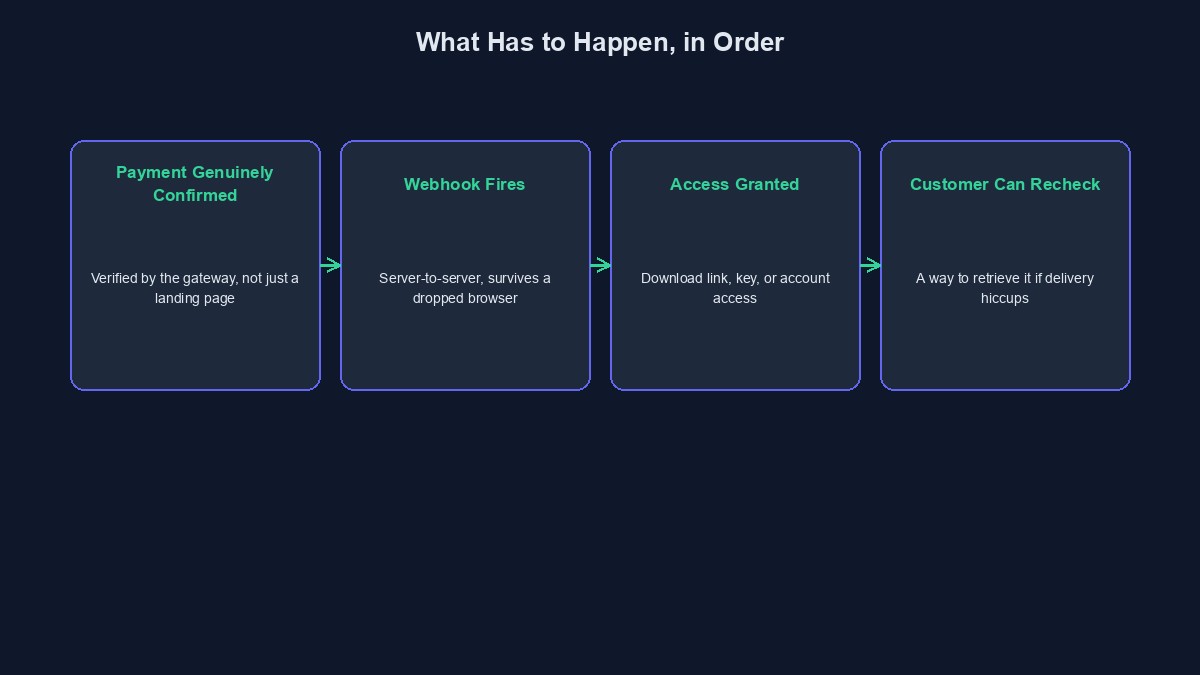
What "automatic delivery" actually has to get right, in order
The sequence sounds simple and is easy to get subtly wrong: a payment has to genuinely, verifiably succeed, not merely appear to on the customer's screen, before access is granted, since granting access on an unconfirmed payment is a direct path to giving your product away for free to anyone willing to interrupt the process at the right moment. Once payment is genuinely confirmed, the actual delivery, a download link, an access code, an emailed licence key, has to happen reliably and close to immediately, since a delay of more than a few minutes on something advertised as instant is where a customer's trust starts to erode, replaced by messages asking where their purchase is.
Why this depends on a webhook, not just a "thank you" page
A common, costly mistake is triggering delivery from the page a customer lands on right after paying, the "thank you, here is your download" page, rather than from a genuine, separate confirmation the payment gateway itself sends your server. The problem: a customer who closes their browser, loses their connection, or has their payment provider redirect imperfectly, at exactly the wrong moment, never triggers that page at all, despite having genuinely paid, and receives nothing while your system has no idea anything went wrong. The correct, reliable approach uses a webhook, an automatic server-to-server notification the payment gateway sends the moment it has genuinely confirmed a payment, entirely independent of whether the customer's own browser session survives the trip back to your site. Our guides to diagnosing a webhook that is not firing and testing webhooks properly before launch cover the mechanics this specific use case depends on directly.
The specific delivery mechanisms, and when each genuinely fits
A direct, time-limited download link, generated fresh and expiring after a set window or a limited number of uses, suits a one-time file, an ebook, a template pack, well, and specifically prevents the link from being shared indefinitely with people who never paid. A unique licence key or access code fits software or anything requiring ongoing, revocable access rather than a single file transfer. Granting access to a private area of your own site, a course platform, a members-only resource library, fits recurring or evolving digital products better than a static file ever could, since the content itself can keep improving after the sale without needing to re-deliver anything.
Protecting a digital product without punishing genuine customers
Some meaningful protection against casual link-sharing is reasonable, expiring download links, watermarked files where that genuinely fits the product, licence keys tied to a specific purchase. Going further than this, aggressive, restrictive digital rights management that makes the product genuinely annoying for a paying customer to actually use, routinely costs more in customer frustration and support requests than it saves in prevented piracy, and it is worth being deliberate about exactly how much friction is actually justified for your specific product rather than defaulting to the most restrictive option available.
What happens when delivery genuinely fails, since it occasionally will
A payment gateway can be briefly slow, a webhook can occasionally not arrive promptly, an email delivering a licence key can land in spam. A well-built digital delivery system does not simply hope this never happens, it has a real, visible way for a customer to check their own order status and request their access again if it did not arrive as expected, without needing to email support and wait, and a genuine, monitored fallback so your own team notices a delivery failure before an frustrated customer has to report it themselves.
Where this stands honestly on a typical ecommerce foundation today
A standard ecommerce store, ours included, is built around physical products, stock levels, shipping addresses, delivery tracking, and does not, out of the box, include automatic digital delivery as a ready-made, configure-and-go feature today. This is worth stating plainly rather than implying otherwise: if your product is genuinely digital, the webhook-triggered delivery logic described in this guide is real, buildable work on top of a payment integration, using exactly the same reliable webhook foundation any Nigerian business already depends on for confirming payments, rather than something you simply toggle on in a generic store settings page.
Refunds: deciding the policy before the first request arrives
Digital products raise a specific question physical ones do not: what does a refund actually mean once a file has been downloaded or an access code has been used. A clear, decided policy, stated before launch rather than improvised under pressure during an actual dispute, protects both sides: some sellers offer no refunds once a download link has genuinely been accessed, others offer a short, genuine trial or satisfaction window before treating access as final. Neither approach is automatically correct, but deciding, writing it down clearly, and applying it consistently avoids the far worse outcome of an inconsistent, case-by-case decision that different customers notice and rightly feel is unfair.
A worked example: a course creator's actual delivery flow
Picture someone selling access to a recorded course, priced as a one-time payment. The actual flow: a customer pays through a real, properly configured gateway integration, and the moment the gateway's webhook confirms that payment genuinely succeeded, not merely that the customer reached a confirmation page, the system automatically creates that customer's access to the course platform and sends a welcome email with their login details. If the customer's own connection drops immediately after paying and they never actually see a confirmation page at all, the delivery still happens correctly, triggered by the webhook rather than by anything dependent on their browser surviving the trip back, and the customer finds their access waiting the next time they check their email, exactly as promised, with no support ticket required on either side.
Mistakes that undermine digital delivery specifically
Triggering delivery from a "thank you" page instead of a genuine payment confirmation webhook. This is the single most common cause of "I paid but got nothing" complaints for digital products, and it is avoidable by building on the correct, reliable mechanism from the start.
No way for a customer to retrieve their own purchase if the first delivery attempt genuinely fails. Requiring a support email and a wait for something advertised as instant defeats much of the actual appeal of selling digitally in the first place.
Overly aggressive protection that meaningfully inconveniences genuine, paying customers. A reasonable amount of protection is sensible; treating every customer like a suspected pirate by default costs more in frustration than it saves.
Assuming a generic ecommerce checkout automatically handles this correctly with no additional work. Digital delivery done properly is a deliberate build on top of a payment integration, not a default behaviour of a physical-goods-oriented store.
A short glossary
Webhook: an automatic server-to-server notification a payment gateway sends the moment it genuinely confirms a payment, independent of the customer's own browser session. Licence key: a unique code granting access to software or a service, tied to a specific purchase and revocable if needed. Time-limited download link: a download link that expires after a set window or number of uses, discouraging indefinite sharing. DRM (digital rights management): technical measures restricting how a digital product can be copied or shared, worth applying proportionately rather than maximally.
Where to go from here
The reliable payment-confirmation foundation this entire guide depends on is real, proven technology already running Nigerian businesses on our platform; our guides to the Paystack API and webhook reliability cover it in depth. If digital product delivery is genuinely what you need built, our custom development team can build exactly this webhook-triggered delivery flow on top of a real payment integration, and you can start building free to see the underlying payment foundation directly first.
Comments
No comments yet. Be the first to share your thoughts.